When Life Gives You Tangerines Ending, Explained by a Korean
Quick answer: The When Life Gives You Tangerines ending is the show's Korean title acted out: 폭싹 속았수다 (pokssak sogatsuda) is Jeju language for “thank you for all your hard work,” and the final episode is one long thank-you to a generation that rarely heard it. As of November 22, 2026, all 16 episodes stream on Netflix in the US, including the Standard with Ads plan, per JustWatch US. Netflix calls it an original story, not an adaptation of a book.

What the title means (and why the ending depends on it)
The Korean title of When Life Gives You Tangerines, 폭싹 속았수다 (pokssak sogatsuda), is a Jeju phrase meaning “you've worked so hard,” or more warmly, “thank you for all your hard work.” That one phrase is the key to the finale, and the English subtitles can't really carry it.
There's a joke baked in, too. To a Seoul ear, sogatda (속았다) sounds like “I got fooled,” a misreading UCLA historian Namhee Lee pointed out to TIME. So plenty of mainland Koreans first read the title as something like “totally duped” before they learned what a Jeju grandmother means by it. The Korea Foundation's Koreana magazine notes that most Koreans aren't familiar with the Jeju vernacular, and the show runs long stretches of dialogue in it. Forbes adds that what you actually hear is a blend of Jeju dialect, standard Korean and Jeolla dialect. If you leaned on subtitles, you weren't alone. A lot of viewers in Seoul were squinting too.
The English title is its own small wink: a twist on “when life gives you lemons,” swapped for the fruit Jeju is known for, as Forbes points out. Cute, but it's the Korean title that tells you how to read episode 16. Keep the phrase in your head (thank you for your hard work) and almost every closing scene turns into someone finally saying it to a person who earned it.
Who the haenyeo are
Haenyeo (해녀) are Jeju women who free-dive for abalone, sea cucumber and seaweed without oxygen tanks, and UNESCO added the culture of Jeju haenyeo to its Intangible Cultural Heritage list in 2016. Ae-sun's mother, Jeon Gwang-rye (Yeom Hye-ran), is one of them, which is why the sea is never just scenery in this show.
The numbers explain the stakes. UNESCO says haenyeo harvest up to seven hours a day, about 90 days a year, holding their breath roughly one minute per dive, and that some divers in their 80s still go down about 10 meters without masks. Visit Jeju, the island's tourism organization, describes breath-holds of one to two minutes at depths of 5 to 20 meters. Netflix's Tudum says the practice has reportedly existed for 1,000 years.
A few things you see on screen have names. The bright orange float is a tewak, with a mesh bag hanging under it for the catch. The whistling “hoi hoi” a diver makes when she surfaces is sumbisori, her breathing sound. The hooked abalone tool, bitchang, is tied to the wrist, and Visit Jeju is blunt that getting tangled in it can kill you. Divers have ranks (UNESCO lists hagun, junggun and sanggun) and pray to Jamsugut, the goddess of the sea.
The work was cold and dangerous, and for many Jeju families it was the money that kept kids fed and in school. Forbes reported that the number of haenyeo fell from about 20,000 in the 1960s to a little over 3,000 by 2025. Hold onto that drop. The finale cares about it.
Spoiler warning: the next two sections reveal how the final episode ends, plus major turns from across the series.
The ending explained: who says thank you to whom
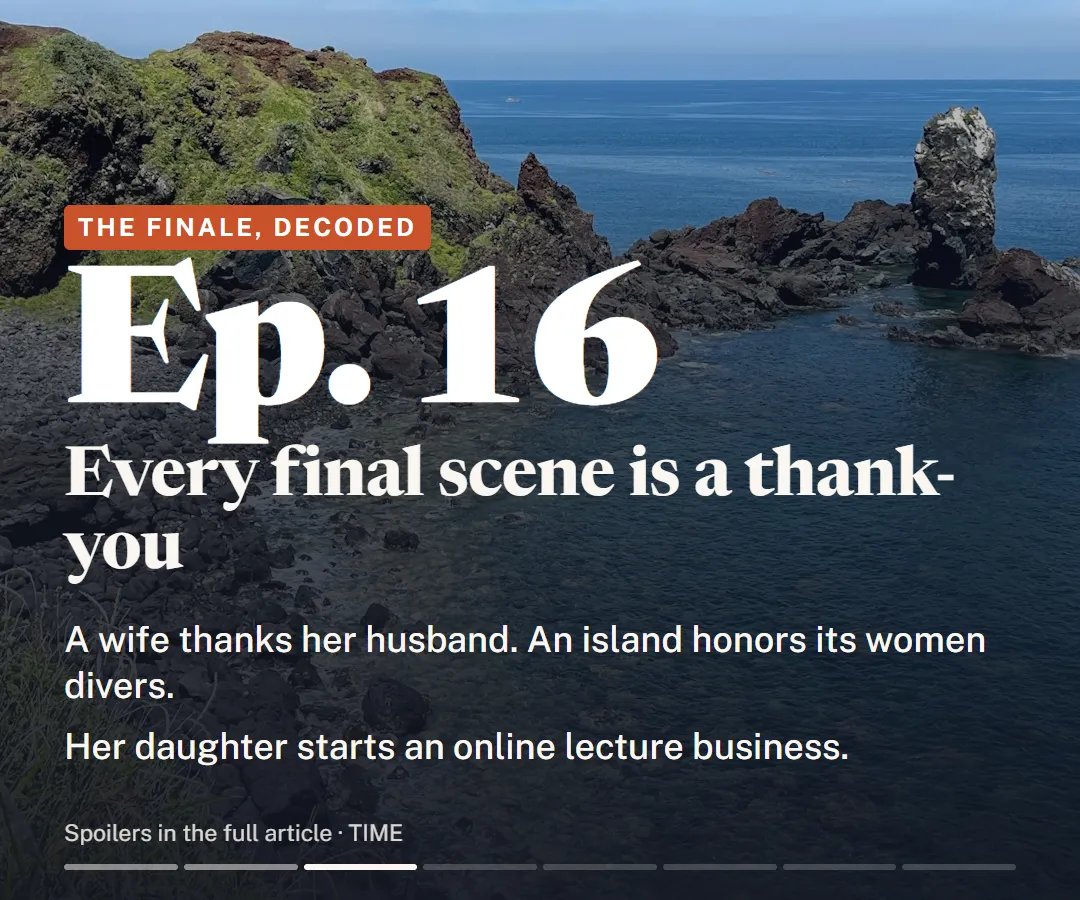
The final episode of When Life Gives You Tangerines, episode 16, ends with Gwan-sik's death and with Ae-sun, the Jeju girl who wanted to be a poet, finally getting her book. Every other closing beat follows the same pattern: someone who spent a life working without thanks finally hears it.
Gwan-sik's goodbye
Gwan-sik (Park Bo-gum when young, Park Hae-joon later) falls ill late in life and dies in the final episode. Before he goes, Ae-sun gives him the line the series has been building toward, as TIME reports it: “Thanks to you, I was never lonely for a day.” It isn't a big speech. It's a wife telling a quiet, steady man that his steadiness counted. That's pokssak sogatsuda in plain words.
Ae-sun's poems and the reading class
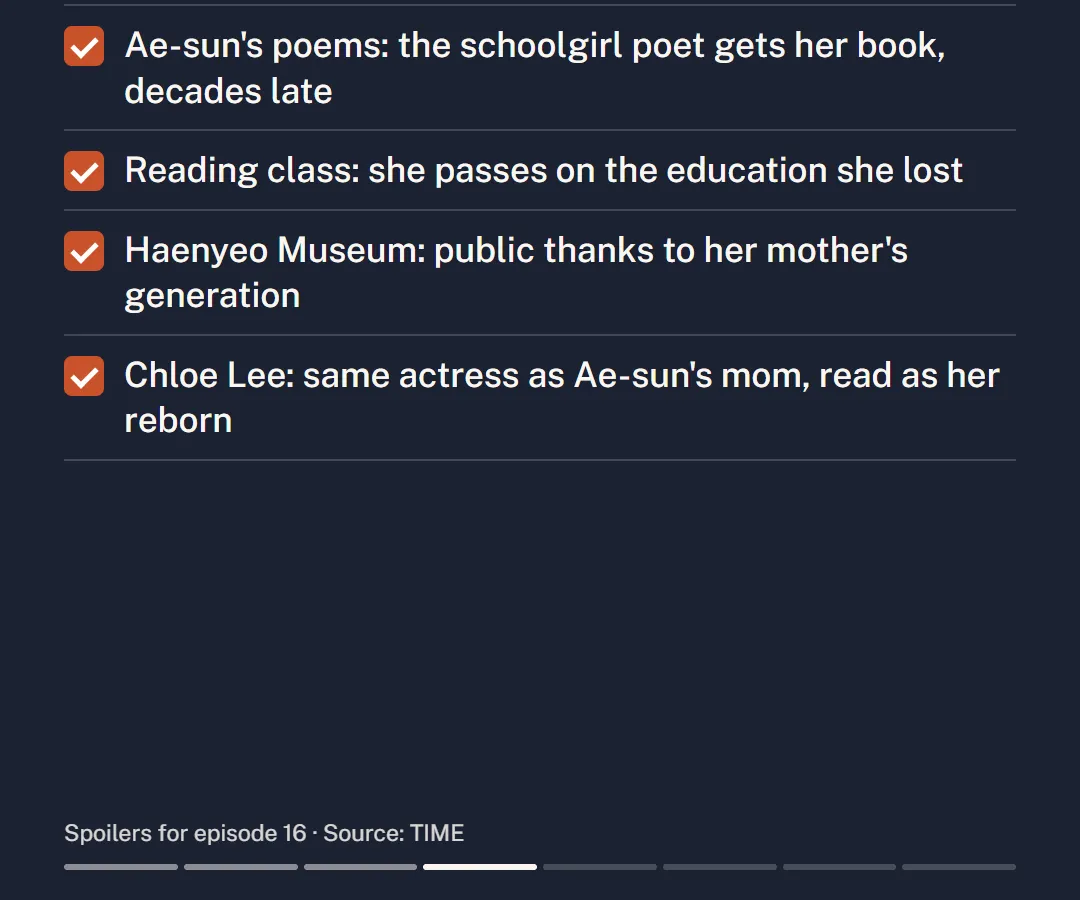
Ae-sun never finished high school, and the show never lets you forget what that cost a sharp, poor girl in 1960s Jeju. In the last stretch she publishes poetry in her 60s and 70s and volunteers teaching residents of a Jeju nursing home to read, write and put their lives into poems, according to TIME. Her daughter Geum-myeong, meanwhile, launches an online lecture business. Put those two side by side and you get the show's quietest argument: one generation of women missed school, and the next one built the classroom.
The Haenyeo Museum
The finale also shows a Haenyeo Museum opening, which TIME flags as one of its Jeju touches. To an American viewer it can look like a tidy bit of local color. For Ae-sun, whose mother went into freezing water so her kids could eat, it's the island finally putting her mother's work on a wall. Given how far the diver count has fallen, it's a little sad, too. Thank-yous tend to come late.
The editor with her mother's face
The editor who works on Ae-sun's book, Chloe Lee, is played by Yeom Hye-ran, the same actress who plays Ae-sun's mother, Gwang-rye. TIME reads it as a reincarnation hint, and Korean viewers jumped to the same idea right away. Here's my reading, and it's an interpretation rather than something the show spells out: a woman who spent her life in the sea comes back with a desk, books and a pen, helping her daughter become the poet she could never afford to be.
Who Geum-myeong ends up with
Geum-myeong (also played by IU) breaks off her engagement to Park Yeong-bum (Lee Jun-young) and later marries Park Chung-seob (Kim Seon-ho), per TIME. If you came for the romance, that's your answer. But notice where the show spends its final minutes. Not on the daughter's wedding. On the parents.
Which ending thread confused you?
The table below gives a one-line answer for each final-episode thread in When Life Gives You Tangerines that viewers most often ask about.
| Thread | What happens | What it means |
|---|---|---|
| Gwan-sik | He falls ill and dies in the final episode. | “Never lonely for a day” is the title, said to him. |
| Ae-sun's poetry | She publishes poems in her 60s and 70s. | The schoolgirl poet gets her book, decades late. |
| The reading class | She teaches Jeju nursing-home residents to read, write and write poems. | She passes on the education she lost to others who missed it. |
| The Haenyeo Museum | A museum for Jeju's women divers opens. | Public thanks to her mother's generation. |
| Chloe Lee | The editor is played by Yeom Hye-ran, who also plays Gwang-rye. | Widely read as the mother reborn, with a desk job this time. |
| Geum-myeong | She ends her engagement to Yeong-bum, marries Chung-seob and starts an online lecture business. | The daughter's success is the parents' payoff. |
| Season 2 | Netflix lists the show as a Limited Series. | Built as one complete story; no season 2 announcement in the sources checked. |
History you might have missed
Three pieces of real Korean history run under When Life Gives You Tangerines, and the subtitles mostly let them slide by without comment.
The March 1960 election. An early episode pairs Ae-sun losing a class election with newspaper coverage of the rigged March 1960 presidential election, as Namhee Lee explained to TIME. A kid cheated out of a school vote, set next to a country cheated out of a national one. Korean viewers catch that in a second.
Slate roofs. In episode 5, thatched roofs come off and slate goes on. That's the New Community Movement (Saemaul Undong, 새마을운동) of the Park Chung-hee era, per Forbes. It looks like a throwaway home-improvement scene. For Koreans it's a whole decade in one shot.
Who got to stay in school. Ae-sun's missing diploma isn't treated as bad luck. The show frames a poor girl's schooling as the first thing to go, then builds its ending around getting it back, through her poems, her reading class and her daughter's lecture company.
The story moves from Jeju to Seoul and Busan across the decades, from the 1960s to the present day, according to Tudum and The Korea Times.

Where to watch and key facts
As of November 22, 2026, When Life Gives You Tangerines streams in the US on Netflix, including the Netflix Standard with Ads plan, and JustWatch US lists no free option. The show is one season of 16 episodes, released four at a time every Friday from March 7 through March 28, 2025.
The show was a genuine hit. The Korea Times reported it ranked No. 1 on Netflix's global non-English TV Top 10 and reached the top 10 in 42 countries. Tudum notes it later won Best Drama at the 61st Baeksang Arts Awards.
| Fact | Detail |
|---|---|
| Korean title | 폭싹 속았수다 (Pokssak sogatsuda), Jeju for “you've worked so hard” |
| Released | March 7 to March 28, 2025, four episodes each Friday |
| Where to watch (US) | Netflix, including Standard with Ads (JustWatch US, November 22, 2026) |
| Episodes | 1 season, 16 episodes; listed by Netflix as a Limited Series |
| Genre | Romance (Netflix listing) |
| Creators | Director Kim Won-suk, writer Lim Sang-choon |
| Main cast | IU (Oh Ae-sun, Yang Geum-myeong), Park Bo-gum (Yang Gwan-sik), Moon So-ri (older Ae-sun), Park Hae-joon (older Gwan-sik), Yeom Hye-ran (Jeon Gwang-rye) |
| Setting | Jeju, Seoul and Busan, from the 1960s to the present day |
| True story? | No. Netflix calls it an original story, not based on a book |
| Reported budget | ₩60 billion (about $44.7 million), per The Korea Times |
| Awards | 61st Baeksang Arts Awards: Best Drama, Best Screenplay (Lim Sang-choon), Best Supporting Actor (Choi Dae-hoon), Best Supporting Actress (Yeom Hye-ran) |
The dollar figure uses ₩1,342 to $1 (ExchangeRate-API, November 22, 2026). Where the show was filmed is a separate question, and that lives in our Korean filming locations section. For more shows explained from a Korean point of view, browse our Korean dramas and movies page.

A Korean's Take
Most American reviews I've read treat Gwan-sik as the dream husband. Fair enough. But the Koreans I know didn't cry over the romance. They cried over their parents.
We say 수고하셨습니다 (sugohasyeotseumnida, thank you for your hard work) all day: to a coworker heading home, to the bus driver, to Mom after she's fed twelve relatives on a holiday. It's so routine it barely registers. This show takes that worn-out phrase, puts it in Jeju dialect, and points it at a whole generation that sold boats, land and cattle so their kids could go to college. Director Kim Won-suk called the series “a tribute to the parent and grandparent generations,” and that's exactly how it played in living rooms here.
The other thing Americans tend to miss is the eldest daughter. Koreans have a half-joking label for her, K-jang-nyeo (K-장녀): the first daughter who carries the family's worries and feels guilty leaving Mom alone. Geum-myeong is that daughter, and a lot of women in their 40s and 50s recognized themselves on sight.
My honest take: the middle episodes drag a bit. Push through anyway. By the time the old women in Ae-sun's class start writing poems, you'll be thinking about somebody's mother too.
Watch it if, skip it if
Watch it if…
- You like slow family stories that cover a whole lifetime.
- You want to understand how Korean parents of the 1960s through the 1980s thought about sacrifice and school.
- You've ever said “thanks, Mom” and not meant it enough.
Skip it if…
- You need a fast plot. Sixteen episodes of roughly an hour each is a real commitment.
- You want a light rom-com. The love story is real, but grief does a lot of the heavy lifting.
- Losing a parent is still raw for you. The finale doesn't soften it.
FAQ
Spoiler warning: the first and third answers reveal parts of the ending.
Does When Life Gives You Tangerines have a happy ending?
The ending is bittersweet. Gwan-sik dies in the final episode, but Ae-sun becomes a published poet and the family's decades of sacrifice clearly pay off.
Is When Life Gives You Tangerines based on a true story?
No. Netflix's Tudum says it's an original story, not based on a book, though it's set against real history such as the March 1960 election fraud, the Saemaul Undong movement and Jeju's haenyeo divers.
Who is Chloe Lee in the last episode?
Chloe Lee is the editor who works on Ae-sun's poetry, and she's played by Yeom Hye-ran, the same actress who plays Ae-sun's mother, Gwang-rye. TIME and many Korean viewers read that casting as a hint that the mother has been reborn.
What does Pokssak sogatsuda mean?
폭싹 속았수다 (pokssak sogatsuda) is Jeju dialect for “you've worked so hard” or “thank you for your hard work.” Speakers of standard Korean can mishear it as “I was fooled,” which turned into a running joke.
Where can I watch When Life Gives You Tangerines in the US, and is there a season 2?
As of November 22, 2026, it streams on Netflix in the US, including Netflix Standard with Ads, per JustWatch US. Netflix lists it as a 16-episode Limited Series, and none of the sources checked for this article mention a season 2.
Sources
- Netflix: When Life Gives You Tangerines title page
- Netflix Tudum: When Life Gives You Tangerines release date, cast and news
- JustWatch US: When Life Gives You Tangerines streaming listing
- UNESCO Intangible Cultural Heritage: Culture of Jeju Haenyeo (women divers)
- Visit Jeju (Jeju Tourism Organization): Culture of Haenyeo Women Divers
- Koreana (Korea Foundation): Feature on When Life Gives You Tangerines and Jeju language
- TIME: The Emotional Ending of When Life Gives You Tangerines
- Forbes: How When Life Gives You Tangerines Explores Korean History and Culture
- The Korea Times: Story of life and love melted into four seasons of Jeju Island
- The Korea Times: Moves viewers with tale of ordinary parents
- The Korea Times: Shows how Korean stories touch audiences across the globe
- ExchangeRate-API: KRW exchange rates, updated November 22, 2026